
The Beauty and Belief Study
The first large-scale international study of beauty in everyday life, examining where people find it, how often, and what difference it makes.
U.S. and U.K.
populations surveyed by Gallup and Verian, March to May 2026
10,695
adults in nationally representative probability samples
100
in-depth interviews on how beauty shapes meaning, belief, and well-being
Key Findings
1. Americans and Britons find beauty in the same places, but Americans find it more often.
Nature, music, relationships, and the moral behavior of others top the list in both countries. The widest gaps are in spiritual or sacred moments and in work.
2. People who encounter beauty more often are flourishing more, and are far less likely to be in distress.
The relationship holds after accounting for age, income, education, and other factors. The association between beauty and flourishing is strongest among people finding it very difficult to get by on their present income.
3. Political identity shapes where people find beauty.
The political left is far more likely to call the arts very important to society in both countries. In the U.S., Republicans are far more likely than Democrats to find beauty in sacred or spiritual moments, but there are no such differences in the U.K.
4. Spirituality, more than religious identity, is associated with valuing beauty.
People who call themselves spiritual, religious or not, are the most likely to say beauty matters for a meaningful life. Religious identity matters more for finding beauty in sacred moments specifically.
5. Men and women find beauty in different domains.
In both countries, women are more likely to find beauty in fashion, literature, and sacred moments; and men more in sports and digital environments.
6. Finding beauty in work matters for flourishing and burnout.
A third of Americans and two in five Britons say their work never feels beautiful. Those who find beauty in accomplishment flourish more, and more frequent beauty at work is associated with lower burnout.
7. Attitudes toward technology are ambivalent.
People who place more importance on beauty are more likely to say AI's long-term risks outweigh its benefits, yet frequent encounters with beauty are associated with a more positive view of social media.

“It’s almost like oxygen. It’s almost necessary.”
— Retired sailor and stained-glass artist, 77, Idaho · U.S. interview
Americans and Britons find beauty in the same areas, but Americans find it more often.
Adults were asked whether they encounter beauty in fifteen domains of life. Nature and the outdoors come first in both countries, followed by music, relationships, and the moral behavior of others. Americans selected eleven domains on average, Britons ten. The largest differences are in the domains of spiritual/sacred moments and work.
Share of adults who say they personally encounter beauty in each area. U.S. n=4,968; U.K. n=5,727.
“It makes you pause, and the world stops.”
— Administrator, 57, upstate New York · U.S. interview
The more often people encounter beauty, the better their well-being.
People who never or almost never experience beauty score an average of 66 on a standard flourishing index, and those who experience it several times a day score 92. Serious psychological distress falls from 29% in the first group to 5% in the second. The pattern holds after adjusting for age, income, country, gender, education, and religious-spiritual identity, and it is strongest among people who say they are finding it very difficult to get by.
Mean Secure Flourishing Index score (0–120) by how often people experienced beauty in the past 30 days.
6×
Serious psychological distress is roughly six times as common among adults who never or almost never encounter beauty as among those who encounter it several times a day.
Share of adults meeting the threshold for serious psychological distress (K6 ≥ 13), U.S. and U.K. combined.
“When you’re in survival mode, it’s harder to see those… the small, beautiful, things.”
— Salon owner, 46, Florida · U.S. interview
Politics, spirituality, and gender
Political identity is associated with where people find beauty. In both countries the political left is far more likely to call the arts very important to society: 66% of Democrats versus 35% of Republicans in the U.S., and 66% of left-wing versus 32% of right-wing respondents in the U.K. The U.S. diverges in one domain: Republicans are 21 points more likely than Democrats to find beauty in spiritual or sacred moments. No comparable divide appears in the U.K.
Spirituality matters more than religious identity for valuing beauty. Adults who describe themselves as spiritual, whether or not they are also religious, are the most likely to say beauty is important to a meaningful life. In both countries, women are more likely than men to find beauty in fashion, literature, and sacred moments, and men more so in sports and the digital environment.
66% of Democrats and 35% of Republicans call the arts very important to society. The U.K. divide is the same: 66% to 32%.
For a third of Americans and two in five Britons, work never feels beautiful.
Work takes up more waking hours than anything else, and it is near the bottom of the fifteen areas where people find beauty. Among those who do find it there, beauty in accomplishment is the source most strongly tied to flourishing, and more frequent beauty at work is linked to lower burnout.
How often adults experienced their main work as beautiful in the past month. "Work" includes paid employment and the daily activity of retirees, homemakers, students, and volunteers.
1 in 3
Americans say their work never feels beautiful. In the U.K. it is more than two in five.
“A beautiful, crisp, clean black top. Perfectly drawn lines.”
— Asphalt plant technician, 37, Georgia, on a newly paved road · U.S. interview
Technology, AI, and Beauty
People are ambivalent towards technology. Those who place more importance on beauty for a meaningful life are more likely to say the long-term risks of AI outweigh its benefits. At the same time, those who encounter beauty several times a day are more likely to say social media has a positive effect on their life (42%) than those who encounter it once in a while or less (30%).
“Noticing of my beautiful surroundings doesn’t happen except in the cell phone dead spot.”
— Federal biologist, 56, Hawaii · U.S. interview
How the study was done
The Beauty and Belief Study combines two nationally representative surveys with a program of in-depth interviews. Survey fieldwork was conducted by Gallup in the United States and Verian in the United Kingdom between March and May 2026. Survey samples were drawn from probability-recruited panels and weighted to national benchmarks. Qualitative interviews were conducted by Gallup from August-November 2026.
United States
Gallup Panel, n = 4,968. Margin of error ±1.85 points.
United Kingdom
Verian Public Voice Panel, n = 5,727. Margin of error ±1.53 points.
Interviews
100 in-depth interviews in the United States and the United Kingdom, 2026.
What was measured
Where and how often people encounter beauty across fifteen areas of life; religious and spiritual life; work, politics, and technology; and well-being (Harvard Secure Flourishing Index, Kessler K6, burnout).
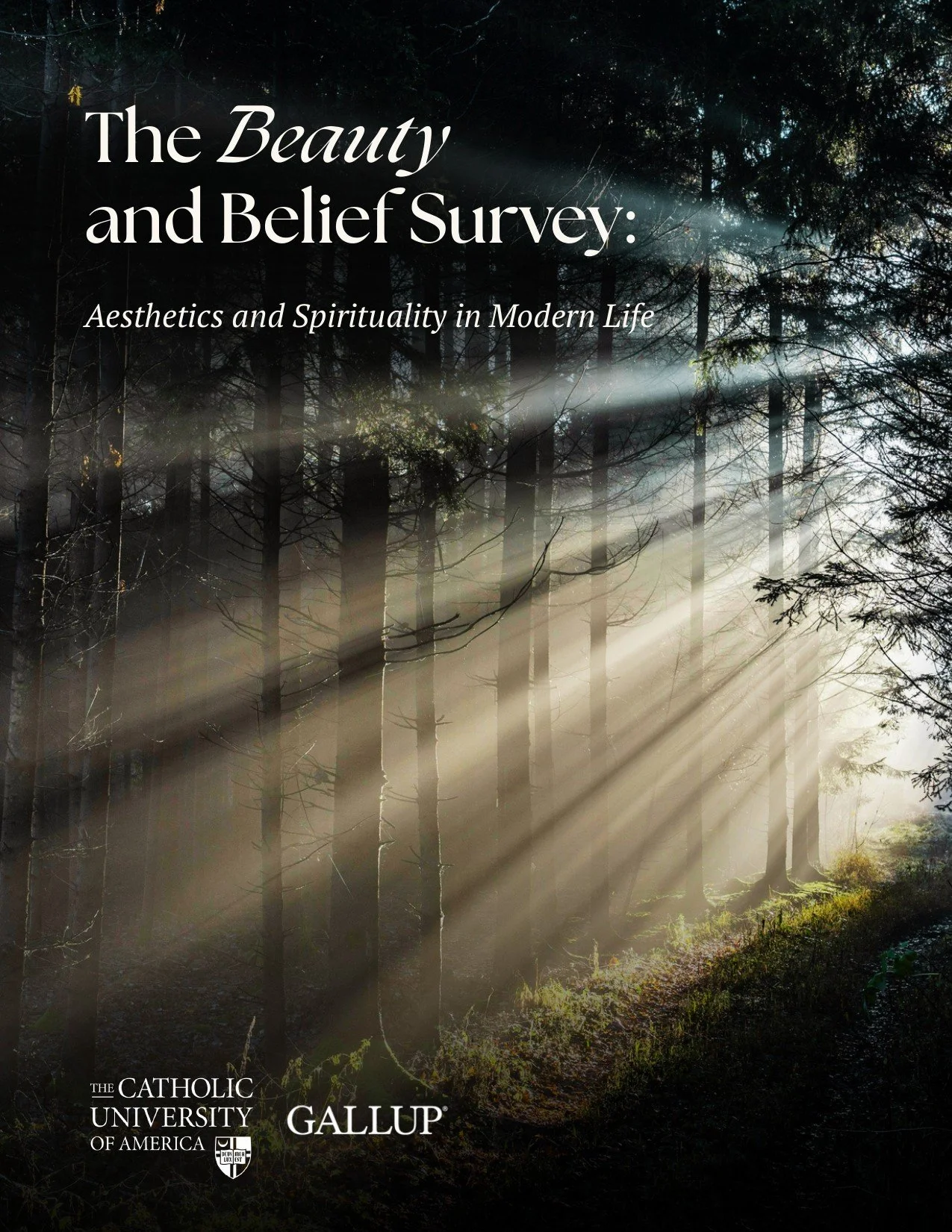
Download the full report
Thirty-four pages, with all tables, charts, and the survey methodology. Published by The Catholic University of America and Gallup, 2026.
Cite as: The Catholic University of America and Gallup (2026). The Beauty and Belief Survey: Aesthetics and Spirituality in Modern Life. Washington, DC.
A partnership of The Catholic University of America and Gallup · Funded by the John Templeton Foundation (#63530)